|
Tibet - Wikipedia
This page was last edited on 3 September 2026, at 05:30 (UTC).
Tibet | History, Map, Capital, Population, Language, & Facts | Britannica
Tibet, historic region and autonomous region of China that is often called ‘the roof of the world.’ It occupies a vast area of plateaus and mountains in Central Asia, including Mount Everest. The name Tibet is derived from the Mongolian Thubet, the Chinese Tufan, the Tai Thibet, and the Arabic Tubbat.
History of Tibet - Wikipedia
Others Retrieved from "https://en.wikipedia.org/w/index.php?title=History_of_Tibet&oldid=1360861709" Categories: History of Tibet Tibet Histories of regions of China History of Asia
Tibet profile - BBC News
Tibet, the remote and mainly-Buddhist territory known as the "roof of the world", is governed as part of China. Historically, Tibet was made up of three major areas - U-Tsang, Amdo and Kham.
Tíbet - Wikipedia, la enciclopedia libre
The Historical Status of China's Tibet. ISBN 7-80113-304-8. Tibet wasn't always ours, says Chinese scholarby Venkatesan Vembu, Daily News & Analysis, February 22, 2007 Wylie, Turrell V. "The First Mongol Conquest of Tibet Reinterpreted", Harvard Journal of Asiatic Studies(Volume 37, Number 1, June 1977) Zenz, Adrian (2014). Tibetanness under ...
Tibet - Simple English Wikipedia, the free encyclopedia
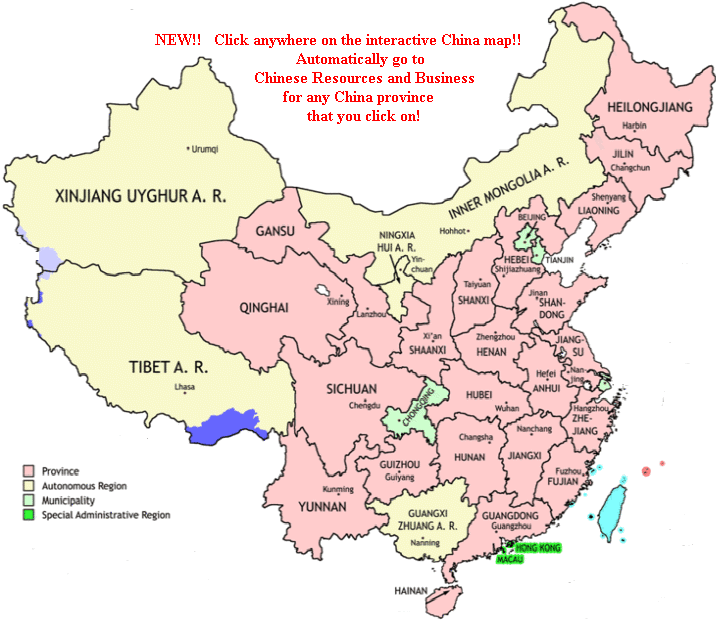
Tibet (བོད, Böd), also called the Tibet Autonomous Region or the Xizang Autonomous Region, is a province-level autonomous region of China (PRC) located on the outer edges of East Asia.
Central Tibetan Administration – Restoring Freedom for Tibetans
August 5, 2026 – By International Campaign for Tibet, 4 August 2026 Two years after his detention for… Reopening Shipki-La: A gateway to Tibet August 5, 2026 Discover how the reopening of Shipki-La revives a historic India–Tibet trade route while reshaping border…
Tibet - Autonomy, Religion, Culture | Britannica
After that the newly installed Chinese administrators relied on military control and a gradual establishment of civilian regional autonomy. Tibet was formally designated a zizhiqu(autonomous region) in 1965, as part of the separation of religion and civil administration.
Tibet at a Glance
Tibet lies at the center of Asia, with an area of 2.5 million square kilometers. The earth’s highest mountains, a vast arid plateau and great river valleys make up the physical homeland of six million Tibetans.
Tibet – Travel guide at Wikivoyage
Text is available under the Creative Commons Attribution-ShareAlike License; additional terms may apply. By using this site, you agree to the Terms of Useand Privacy ...
|


 FIRE101 Fire Jobs